
Soft Tissue
Gum Grafting
When recession of the gingiva occurs, the body loses a natural defense against both bacterial penetration and trauma. When gum recession is a problem, gum reconstruction using grafting techniques is an option.
When there is only minor recession, some healthy gingiva often remains and protects the tooth, so that no treatment other than modifying home care practices is necessary. However, when recession reaches the mucosa, the first line of defense against bacterial penetration is lost.
In addition, gum recession often results in root sensitivity to hot and cold foods as well as an unsightly appearance of the gum and tooth. When significant, gum recession can predispose to worsening recession and expose the root surface, which is softer than enamel, leading to root caries and root gouging.
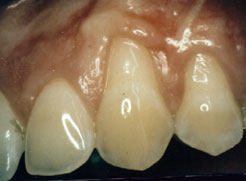
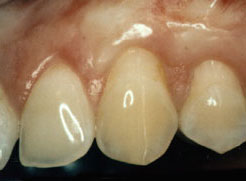
Before and After Gum Grafting
A gingival graft is designed to solve these problems. A thin piece of tissue is taken from the roof of the mouth or gently moved over from adjacent areas to provide a stable band of attached gingiva around the tooth. The gingival graft may be placed in such a way as to cover the exposed portion of the root.
The gingival graft procedure is highly predictable and results in a stable, healthy band of attached tissue around the tooth.
Soft-tissue Grafting
Healthy teeth and dental implants require both gum tissue and bone for support. Healthy gum tissue (soft tissue) forms a protective barrier. This barrier protects against oral bacterial and stresses from daily functions such as chewing and tooth brushing. Without adequate gum tissue and bone (hard tissue), teeth and dental implants may become compromised. This may cause tooth sensitivity or an unattractive smile from receding gums. It can lead to premature tooth loss or dental implant failure.
What is a Soft-tissue Graft?
A soft-tissue graft is a piece of gum tissue (soft tissue) that is surgically transplanted to a site inside the mouth. The piece of gum tissue used for surgery is called donor tissue. The surgery site where the gum tissue is placed is known as the recipient site.
Why is a Soft-tissue Graft Needed?
Soft-tissue grafting are procedures performed inside the mount to increase the amount of gum tissue around a single tooth, multiple teeth or dental implants. In cases of tooth loss, soft-tissue grafting can build more gum tissue to support dentures. Less commonly, soft-tissue grafts may be used to build gum tissue in non-tooth bearing areas, like the floor of the mouth (underneath the tongue) or cheek tissue.
Soft tissue may be inadequate for many reasons:
- Gum and bone disease (periodontal disease)
- Forceful tooth brushing or flossing
- Traumatic injury
- Orthodontic movement of teeth (braces or aligners)
- Previous oral surgery such as dental extractions
- Treatment for oral pathology, including head and neck cancer
- Loss of teeth at an early age
- Systemic disease (e.g., diabetes mellitus, rheumatoid arthritis, lupus)
Our surgeons can diagnose and treat soft-tissue problems with soft-tissue grafting.
Where Do Soft-tissue Grafts Come From?
Soft-tissue grafts for oral surgery are typically obtained from one of three sources:
- Nearby gum tissue– Adjacent healthy gum tissue inside your mouth is moved over and repositioned into the recipient site. This is commonly referred to as a pedicle flap. this technique requires neighboring healthy gum tissue. If the neighboring tissue is not healthy, another technique may be recommended.
- Roof of the mouth gum tissue (palatal tissue)– Healthy gum tissue is taken from the roof of your mouth (palate) and transplanted into the recipient site. The palatal gum tissue has multiple layers. We may elect to transfer all layers of palatal tissue, termed a free gingival graft. Alternatively, only some of layers are transferred, while other layers remain. This graft is termed a sub-epithelial connective tissue graft.
- Acellular dermal matrix (cadaver tissue) -Acellular dermal matrix is human cadaver donor tissue, which is placed into the recipient site. All cadaver donor tissues are processed according to the U.S. food and Drug Administration (FDA) standards. All cells from the human donor are completely removed in the process. This renders the donor tissue acellular. This prevents the transfer of any cells or potential disease to recipient patients. Using donor tissue avoids having two surgery sites inside the mouth.
Performing Soft Tissue Grafts
Soft-tissue grafting may be performed as a separate procedure or simultaneously with other procedures. At times, both soft tissue and hard tissue around teeth or dental implants are deficient. It may be recommended to increase both the amount of gum tissue and bone. Soft-tissue grafting may be performed with a combination of local anesthesia, moderate sedation, deep sedation or general anesthesia. We will help you decide what approach is best for your specific situation.
Graft and Donor Site Healing
Healing time from soft-tissue grafting is variable. Recovery is dependent on many factors, including the type of graft, procedure performed and adjunctive materials used. Healing may be related to the specific surgery site and size of the soft-tissue defect. Patient factors such as diabetes and smoking affect recovery and overall success rates. Stitches are commonly placed inside the mouth to secure the soft-tissue graft, but stitches do not always require removal. We will provide specific postoperative care instructions and guidelines for what to expect after surgery.
Contact Heine, Heine, & Bowles about Soft-tissue Grafting
Oral and maxillofacial surgeons treat patients with soft-tissue defects around teeth, dental implants and other oral sites utilizing a variety of surgical procedures. Contact Heine, Heine, & Bowles Oral and Maxillofacial Surgery to discuss soft-tissue grafting to improve your overall oral health.